
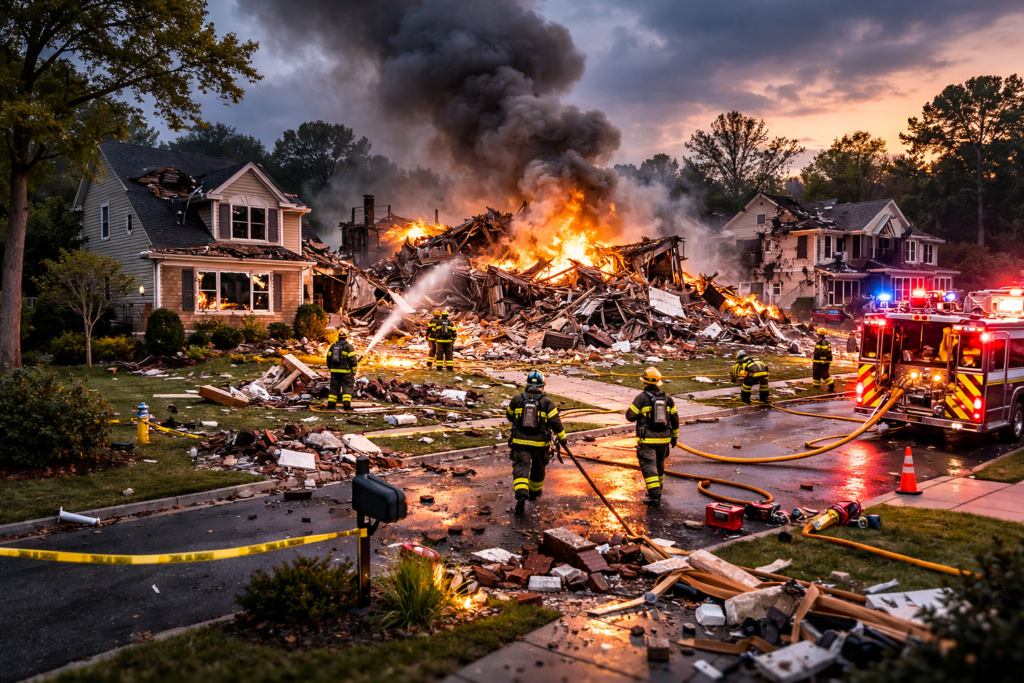
On the evening of August 19, 2025, a devastating event shook the quiet Glenmore subdivision in Keswick, Virginia. A large two‑story home on Ferndown Lane exploded with tremendous force, leaving a once‑peaceful neighborhood reeling from loss, damage, and unanswered questions. Known today as the Glenmore house explosion, this incident continues to inform discussions about residential gas safety and community resilience.
This article takes a detailed and human‑centered look at what occurred, the impact on individuals and the broader community, how investigators approached the cause, and the important safety lessons that emerged.
Understanding the Incident: What Happened on August 19
Around 6:00 p.m. on August 19, 2025, emergency services in Albemarle County received multiple reports of a loud blast and billowing debris in the Glenmore neighborhood. Fire and rescue crews from Albemarle County arrived within minutes to find a large home completely leveled, with neighboring properties showing signs of significant damage.
The home at 2331 Ferndown Lane was destroyed almost entirely. Debris — including bricks, insulation, and fragments of the home’s structure — was scattered across adjacent yards, with some residents reporting that their houses shook from the blast.
Emergency responders quickly located two victims at the scene. One person was critically injured and transported to a trauma center for treatment, while the other was found deceased inside the rubble.
Casualties and Immediate Human Impact
Tragically, the woman found deceased was later identified as 76‑year‑old Justine M. Joscelyne, a local resident who was at the property when the explosion occurred.
According to local reports, she had arrived at the home because she noticed a strong smell of gas, and had called a male acquaintance for help in tracing the source of the odor. Moments later, the explosion occurred, killing her and severely injuring the man, who was taken to the Evans‑Haynes Burn Center at Virginia Commonwealth University for treatment.
Though the homeowners were away at the time of the incident, Joscelyne and the male victim were present to investigate the suspicious gas smell.
Initial Investigation: Gas Leak as a Likely Cause
In the immediate aftermath, fire officials from Albemarle County described the explosion as likely related to a gas leak. Investigators focused on gas appliances and the home’s distribution systems as potential origins of the blast. Officials urged residents to remain vigilant and report any signs of gas or leakage.
At a press conference the day after the explosion, Fire Rescue Chief Dan Eggleston emphasized the preliminary nature of the investigation, noting that crews were committed not only to determining the cause but also to supporting the affected community as it began to recover.
The explosion also drew support from several agencies, including the Virginia State Police, the Virginia Department of Emergency Management, and the Bureau of Alcohol, Tobacco, Firearms and Explosives (ATF), all working together to piece together what went wrong.
Further Findings: Weather‑Related Cause Proposed
In the months following the incident, additional analysis led investigators to consider a weather‑related trigger for the explosion. By October 2025, Albemarle County’s fire chief publicly suggested that a lightning strike had possibly ruptured a buried gas line at the home days before the blast.
According to this theory, a lightning strike ruptured the gas line, creating a slow leak that filled the house with gas. When the residents entered and unknowingly introduced an ignition source — possibly flipping a light switch or using a device — the accumulated gas ignited in a catastrophic explosion.
This explanation highlights the complex interplay between natural forces and residential infrastructure, especially in areas that rely on underground gas or propane systems.Community Impact and Response
The explosion didn’t just affect one home; the blast damaged at least twelve neighboring homes, with varying degrees of severity. Some structures required evacuation due to compromised roofs, shattered windows, and other blast impacts. Residents in the area were temporarily displaced, and many turned to the American Red Cross for assistance with emergency housing and support services.
Insurance claims related to damage and repairs also began to mount rapidly in the days following the incident. Local adjusters noted that while some properties only needed minor repairs, others could face long‑term rebuilding.
For neighbors, the explosion served as a jarring reminder of how quickly everyday safety can be compromised. Windows, roofs, vehicles, and personal property in some areas were damaged by flying debris, and the psychological impact of a sudden explosion in a residential community has been profound for many families.
Safety Lessons and Preparedness
The Glenmore house explosion underscores important safety lessons for homeowners everywhere, particularly in communities that use propane or natural gas systems. Some key takeaways include:
1. Prompt Response to Gas Odors
Any unusual smell of gas should trigger immediate action — evacuate the building and notify authorities without delay. Gas leaks can quickly reach dangerous concentrations, even if the source is not immediately evident.
2. Regular Maintenance and Inspection
Periodic professional inspections of gas lines, appliances, and tanks can help identify vulnerabilities before they become emergencies.
3. Awareness of Environmental Hazards
Understanding how natural events — such as lightning strikes — might impact buried gas infrastructure can inform preventive strategies, including ground inspection after severe weather.
4. Community Preparedness and Emergency Planning
Neighborhoods can benefit from coordinated safety planning, including clear communication channels during emergencies and shared knowledge about where utility shutoffs and emergency support services are located.
Looking Ahead: Recovery and Resilience
Months after the blast, efforts in Glenmore continue to focus on rebuilding and ensuring safety. While investigations have provided insight into possible causes, community leaders, fire officials, and homeowners remain vigilant in preventing similar disasters.The legacy of the Glenmore house explosion is a reminder of the fragility of residential safety systems and the importance of preparedness, community support, and careful attention to warning signs. To many in Albemarle County, the event was more than a news story — it was a lived experience that reshaped how they think about home safety and neighborhood security.