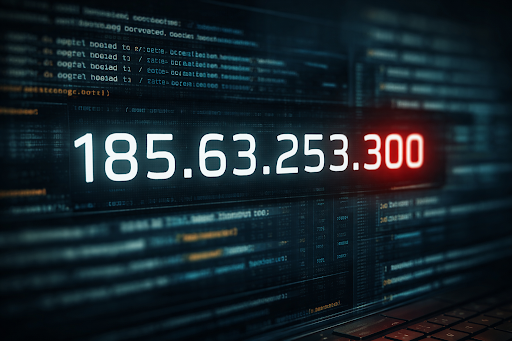
The keyword 185.63.253.300 looks like a standard IP address at first glance. It follows the familiar pattern of four numbers separated by dots. However, if you look closely, you will notice something important: this is not a valid IP address.
Many people encounter 185.63.253.300 in server logs, analytics reports, firewall records, or online searches. This often raises questions. Is it real? Is it dangerous? Can it be traced? Or is it just a technical mistake?
In this article, we will break down everything you need to know about 185.63.253.300 in clear and simple terms. By the end, you will understand why it cannot exist on the internet and what it means if you see it in your data.
What Is 185.63.253.300?
At a glance, 185.63.253.300 appears to be an IPv4 address.
An IPv4 address is a numerical label assigned to devices connected to a network. It helps computers identify and communicate with each other across the internet.
A typical IPv4 address looks like this:
192.168.1.1
Each IPv4 address contains four numbers separated by dots. These numbers are called octets.
The problem with 185.63.253.300 lies in the last number: 300.
Understanding IPv4 Address Structure
To understand why 185.63.253.300 is invalid, we need to look at how IPv4 addresses work.
H3: The 0–255 Rule
Each octet in an IPv4 address must be a number between 0 and 255.
This is because each octet is made up of 8 bits in binary form. With 8 bits, the highest possible number is 255.
So valid examples include:
- 185.63.253.30
- 8.8.8.8
- 172.16.0.1
But 185.63.253.300 is not valid because 300 exceeds the maximum limit of 255.
H3: Why 300 Cannot Exist in IPv4
When a device tries to interpret an IP address, it checks whether each number fits within the allowed range.
Since 300 is larger than 255, networking systems immediately reject it. That means:
- It cannot be assigned to a server.
- It cannot be pinged.
- It cannot host a website.
- It cannot belong to a real internet service provider.
In simple terms, 185.63.253.300 cannot exist on the public internet.
Why Does 185.63.253.300 Appear in Logs?
If this IP address is invalid, why do people keep searching for it or finding it in logs?
There are several possible explanations.
H3: Typographical Errors
One of the most common reasons is a typing mistake.
For example, someone may have meant to write:
185.63.253.30
But accidentally added an extra zero at the end.
Even a small typing error can create an invalid IP format.
H3: Misconfigured Software
Sometimes applications or scripts fail to validate user input correctly.
If a system does not properly check whether each octet stays within the 0–255 range, it may store or display an invalid IP like 185.63.253.300.
This is often a software validation issue rather than a real network threat.
H3: Bot or Spam Activity
Automated bots sometimes generate random numerical strings to test forms, scanners, or logging systems.
These bots may not follow proper IP formatting rules. As a result, invalid addresses like 185.63.253.300 can appear in traffic logs.
H3: Placeholder or Dummy Data
Developers often use sample or dummy IP addresses while testing applications.
Although common placeholders are usually valid ranges reserved for documentation, some developers may type random numbers for testing purposes.
Is 185.63.253.300 Dangerous?
The short answer is no.
Since 185.63.253.300 is not a valid IP address, it cannot:
- Connect to your server
- Launch a real attack
- Host malware
- Be traced to a country or ISP
However, its presence might still indicate something worth checking.
H3: When You Should Pay Attention
If you repeatedly see 185.63.253.300 in:
- Web server logs
- Firewall alerts
- Analytics tools
- Application error reports
It may point to:
- A logging or validation bug
- Improper data filtering
- Automated spam traffic
- Input validation weaknesses
While the IP itself is not a threat, the system that allowed it may need review.
How to Check Whether an IP Address Is Valid
If you are unsure whether an IP address is valid, you can use a few simple checks.
H3: Manual Validation
Check each of the four numbers:
- Are they between 0 and 255?
- Are there exactly four sections separated by dots?
- Are there no extra spaces or characters?
If any number exceeds 255, the address is invalid.
H3: Using Command Prompt
You can try pinging the address.
For example:
ping 185.63.253.300
The system will fail to resolve it because it does not meet IP formatting standards.
H3: Online IP Validation Tools
Many free tools automatically verify IP format. They instantly flag numbers outside the allowed range.
The Difference Between Invalid and Private IP Addresses
Some people confuse invalid IP addresses with private IP addresses.
Private IP addresses are valid but reserved for internal networks. Examples include:
- 192.168.x.x
- 10.x.x.x
- 172.16.x.x
These are legitimate but not publicly accessible.
In contrast, 185.63.253.300 is invalid because it violates the numeric rule of IPv4 formatting.
Could 185.63.253.300 Be an IPv6 Address?
No.
IPv6 addresses use a completely different format. They include letters and colons, such as:
2001:0db8:85a3:0000:0000:8a2e:0370:7334
Since 185.63.253.300 follows the IPv4 dot-decimal format, it cannot be interpreted as IPv6 either.
SEO and Search Curiosity Around 185.63.253.300
Interestingly, many people search for unusual IP addresses online.
There are several reasons for this trend:
- Curiosity after seeing the IP in logs
- Suspicion of hacking attempts
- Confusion caused by error messages
- Research for cybersecurity articles
Because 185.63.253.300 looks realistic at first glance, it often attracts attention.
This makes it a strong keyword for educational and cybersecurity-related content.
What Should Website Owners Do?
If you manage a website and encounter 185.63.253.300, here are some practical steps.
H3: Review Input Validation
Ensure your forms and applications validate IP addresses properly.
Each octet should be checked to confirm it falls within 0–255.
H3: Monitor Traffic Patterns
Look for repeated unusual entries.
If invalid IP addresses appear frequently, you may be dealing with automated bots.
H3: Update Security Rules
Most modern firewalls and web servers automatically reject malformed IP addresses.
Make sure your systems are updated and properly configured.
Common Questions About 185.63.253.300
Is 185.63.253.300 a real server?
No. It cannot exist as a valid IPv4 address.
Can it hack my website?
No. Since it is not a real IP, it cannot initiate a real network connection.
Why do people search for it?
Most people search for it after seeing it in logs or error messages and wanting clarification.
Can it be traced to a country?
No. Because it does not exist, it cannot be linked to any geographic location.
Final Thoughts
185.63.253.300 may look like a legitimate IP address, but it fails one critical rule of IPv4 formatting. The final octet exceeds the maximum allowed value of 255, making it technically impossible.
If you see 185.63.253.300 in your logs, there is no need to panic. It cannot host malware, attack your server, or represent a real device on the internet.
However, its presence can highlight small technical issues, such as input validation errors or automated bot activity.
Understanding how IP addresses work helps you avoid confusion and respond calmly to unusual entries. In the case of 185.63.253.300, the explanation is simple: it is not real, and it cannot function on any network.
By learning the basics of IPv4 structure and validation, you can quickly identify invalid addresses and keep your systems running smoothly.